

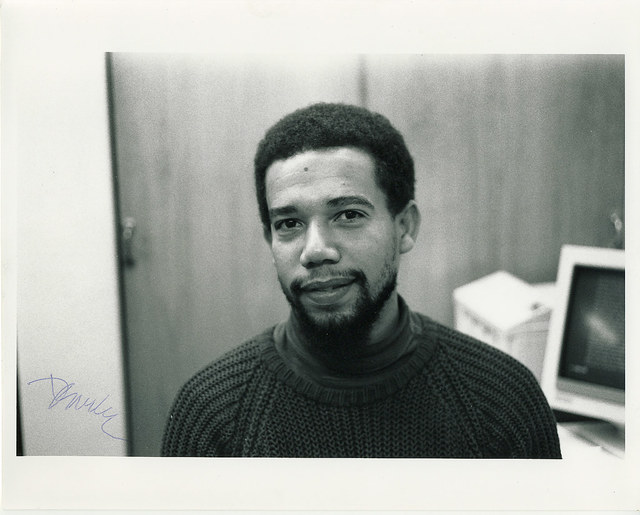
Daniel Simidor was born on January 30th, 1955, in St. Louis du Nord, Haiti. He became an educator, teaching literature and history in Haitian secondary schools. After studying at the Université Louis Pasteur in Strasbourg, France, Simidor settled in New York in the late 1970s, where he studied at York College in its Black Studies program. The Black Studies' mission is to provide interdisciplinary intellectual space where students critically examine, analyze, and interpret African, African American, and Caribbean experiences.
The historical events leading to Simidor’s enrollment at York College might have cultivated his framework for working in the archives. 1969 was deemed a Black Revolution as it was the height of Black student activism across U.S. college campuses. Student activists in the late 1960s countered the sit-in student movements of the early 1960s. As commonly noted at Historically Black Colleges and Universities and public universities such as CUNY’s The City College of New York and Brooklyn College. Students wanted Black culture and history to be at the forefront of their movement and to rebuke institutions that uphold white, imperial ideologies. The movements that sparked across college campuses showed a desire for students to obtain an education in ways that have yet to be seen on campuses: quality Black education and life studies. Students wanted to share in the rewards of American citizenship and saw that institutionalizing Black studies could be a means to expose the United States’s inability to allow them to get there. This political space and Simidor’s lived experience as a Black, Haitian man living in New York, would frame Simidor's education at CUNY’s York College and his work at the Schomburg and beyond.
Simidor began working at Schomburg in 1982 as a library technical assistant at the Mid-Manhattan branch, transferring to the Schomburg center a year later, aiming to: collect, preserve, and publicly share Black collections. His memoriam published by the New York Public Library, describes him having had a breadth of knowledge about Haitian, African, and Caribbean histories in addition to, “a profound grasp of African-American civil rights and labor history, and the fundamentals of Black Nationalism, the black arts movement, communist history and theory, and related areas.” While there, Simidor also processed the works of revolutionaries such as Malcolm X.
As Simidor curated, he produced written pieces that expressed liberatory ideologies for people whose stories often go untold in mainstream news. In his writing and curations, we see a throughline of self-determination and nuance in the Black experience in the United States.
Daniel Simidor te fèt 30 janvye 1955, nan Saint-Louis du Nord, Ayiti. Li te vin yon edikatè, li te anseye literati ak istwa nan lekòl segondè ann Ayiti. Apre li te fin etidye nan Inivèsite Louis Pasteur nan Strasbourg, an Frans, Simidor te viv nan Nouyòk nan fen ane 1970 yo, kote li te etidye nan York College nan pwogram Black Studies (Black Studies). Misyon pwogram sa se bay yon espas entelektyèl entèdisiplinè kote elèv yo egzamine, analize epi entèprete eksperyans afriken, afriken ameriken ak karayib yo avèk yon je kritik.
Evènman istorik ki te mennen Simidor nan York College te ka devlope kad travay li nan achiv yo. Yo te konsidere ane 1969 kòm yon Revolisyon Nwa paske se te pik aktivis etidyan Nwa yo atravè kanpis inivèsite ameriken yo. Aktivis etidyan nan fen ane 1960 yo te kontrekare mouvman etidyan sit-in yo nan kòmansman ane 1960 yo. Jan yo te souvan note sa nan Kolèj ak Inivèsite Istorikman Nwa yo ak inivèsite piblik tankou The City College of New York nan CUNY ak Brooklyn College. Etidyan yo te vle kilti ak istwa Nwa yo te nan premye plan mouvman yo a epi pou yo te denonse enstitisyon ki defann ideyoloji blan ak enperyal yo. Mouvman ki te deklanche atravè kanpis inivèsite yo te montre yon dezi pou etidyan yo jwenn yon edikasyon nan fason yo poko wè sou kanpis yo: edikasyon Nwa kalite siperyè ak etid lavi. Etidyan yo te vle pataje rekonpans sitwayènte ameriken an epi yo te wè ke enstitisyonalize etid Nwa yo te kapab yon mwayen pou ekspoze enkapasite Etazini pou pèmèt yo rive la. Espas politik sa a ak eksperyans Simidor kòm yon Ayisyen Nwa k ap viv nan Nouyòk, ta ankadre edikasyon Simidor nan York College CUNY a ak travay li nan Schomburg ak pi lwen.
Simidor te kòmanse travay nan Schomburg an 1982 kòm yon asistan teknik bibliyotèk nan branch Mid-Manhattan an, li te transfere nan sant Schomburg la yon ane apre, avèk objektif pou: kolekte, prezève, epi pataje koleksyon Nwa yo piblikman. Memoryal li a, pibliye pa Bibliyotèk Piblik Nouyòk la, dekri li kòm yon moun ki te gen yon konesans laj sou istwa Ayiti, Afriken, ak Karayibyen anplis de "yon konpreyansyon pwofon sou dwa sivil ak istwa travay Afriken-Ameriken yo, ak fondamantal Nasyonalis Nwa yo, mouvman atistik nwa yo, istwa ak teyori kominis la, ak domèn ki gen rapò." Pandan l te la, Simidor te trete tou travay revolisyonè tankou Malcolm X.
Pandan Simidor t ap òganize ekspozisyon, li te pwodui tèks ki te eksprime ideoloji liberasyon pou moun ki gen istwa souvan pa rakonte nan nouvèl prensipal yo. Nan ekriti ak koleksyon ekspozisyon li yo, nou wè yon liy otodeterminasyon ak nuans nan eksperyans Nwa yo Ozetazini.
Reflections, Multimodal Processes & Explorations /* ***Refleksyon, Pwosesis Multimodal ak Eksplorasyon*
Music 💿 is an integral aspect of my (Herline’s) Haitian cultural identity. When I learned that the HSI archives will house a physical records collection, I was immediately taken back to my dad’s 1992 Toyota Camry growing up, listening to all the classics as he drove me and my siblings home from our after school program. I was excited for the additional layer of community the space will bring just as I am excited for the community this project might bring. As you navigate this project, you are welcome to play a song or two from the playlist or play some of the songs you and your community grew up with. If you are moved by physical records, visit HSI archives and explore their records collection.
Mizik 💿 se yon aspè entegral nan idantite kiltirèl ayisyèn mwen (Herline). Lè m te aprann ke achiv HSI a pral gen yon koleksyon dosye fizik, mwen te santi m retounen touswit nan Toyota Camry 1992 papa m nan lè m t ap grandi, ap koute tout klasik yo pandan l t ap kondui mwen menm ak frè ak sè m yo lakay nou sot nan pwogram apre lekòl nou an. Mwen te eksite pou kouch kominote siplemantè espas la pral pote menm jan mwen eksite pou kominote pwojè sa a ka pote. Pandan w ap navige nan pwojè sa a, ou lib pou jwe youn oubyen de chante nan playlist la oubyen jwe kèk nan chante ou menm ak kominote w la te grandi avèk yo. Si dosye fizik yo touche w, vizite achiv HSI epi eksplore koleksyon dosye yo.
Visualizing 📊 the archives has allowed me to see what this collection has to offer. I used my notes as a data bank on Voyant Tools. This has allowed me to quickly identify the boxes where I’ve gotten the most data (Box B1) and the keywords that populated the most in my explorations. What are you noticing?
*Vizyalize 📊 achiv yo pèmèt mwen wè sa koleksyon sa a gen pou l ofri. Mwen te itilize nòt mwen yo kòm yon baz done sou Voyant Tools. Sa pèmèt mwen idantifye byen vit bwat kote mwen te jwenn plis done yo (Bwat B1) ak mo kle ki te peple plis nan eksplorasyon mwen yo. Kisa w ap remake?*